




- Could you give us an overview of your research?
- What inspired you to pursue this research topic?
- What do you consider to be the most distinctive features and strengths of this research?
- What future directions and potential societal applications do you foresee for this research?
- What would you like to say to inspire early-career researchers, students, and society at large?
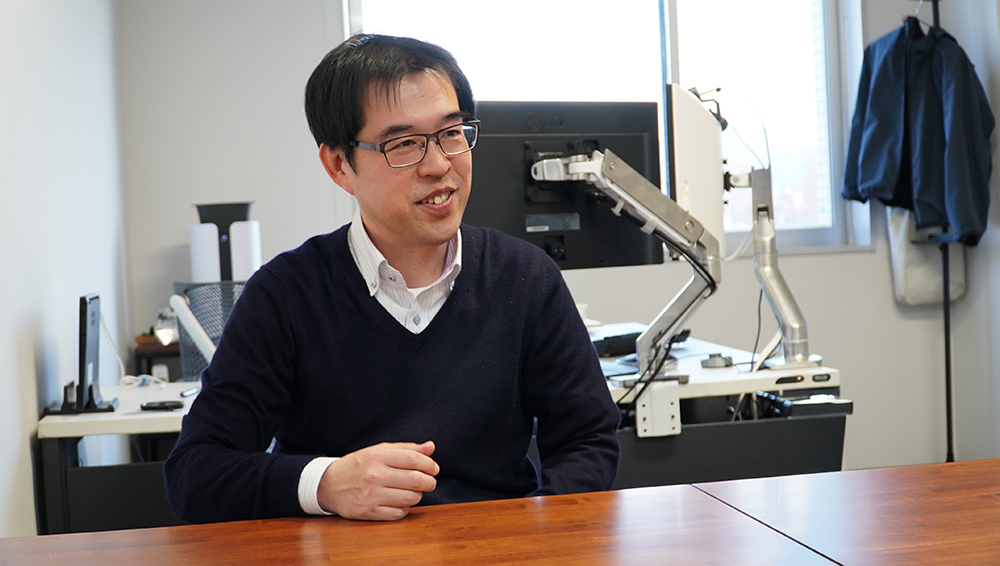
Could you give us an overview of your research?
My research centers on organic optoelectronics, particularly utilizing organic molecules as semiconductor materials. Although organic molecules are typically considered electrical insulators, careful molecular design allows us to modify their properties to function as semiconductors. Many of them also possess excellent light-emitting capabilities, which is why organic light-emitting diodes (OLEDs) are now widely used in displays like smartphones and TVs.
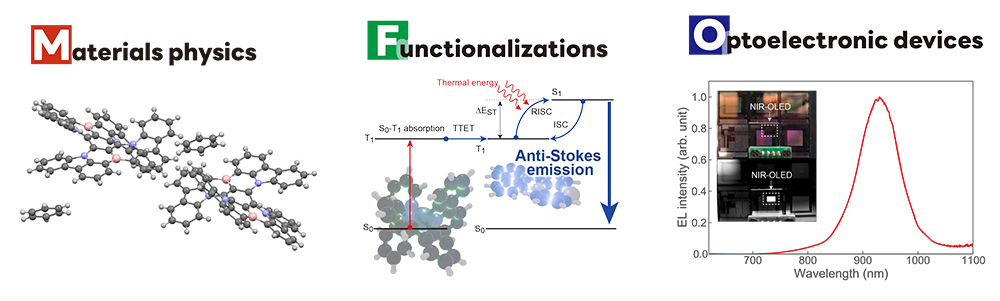
In our laboratory, we strive to create innovative optoelectronic devices by exploiting the diverse functions of organic molecules. Our work spans fundamental studies in condensed-matter physics to applied research for future technologies. Recently, we have been investigating new areas, such as near-infrared OLEDs for sensing and optical cooling devices that leverage quantum states of organic molecules. Through these efforts, we aim to uncover entirely new functionalities not yet realized in current devices.
What inspired you to pursue this research topic?
I have been working on organic optoelectronics since 2005. In particular, I focused on both fundamental and applied research aimed at improving the performance of OLED devices and enabling their practical implementation. Some of these research outcomes have been incorporated into display technologies used today.As OLED displays became widely adopted in society, I began to feel that exploring the next stage of organic semiconductor technology should be an important mission for researchers in academia.
For this reason, I decided to pursue research topics that are more exploratory and challenging topics that may not immediately lead to practical applications but could open up new technological possibilities in the future.
What do you consider to be the most distinctive features and strengths of this research?
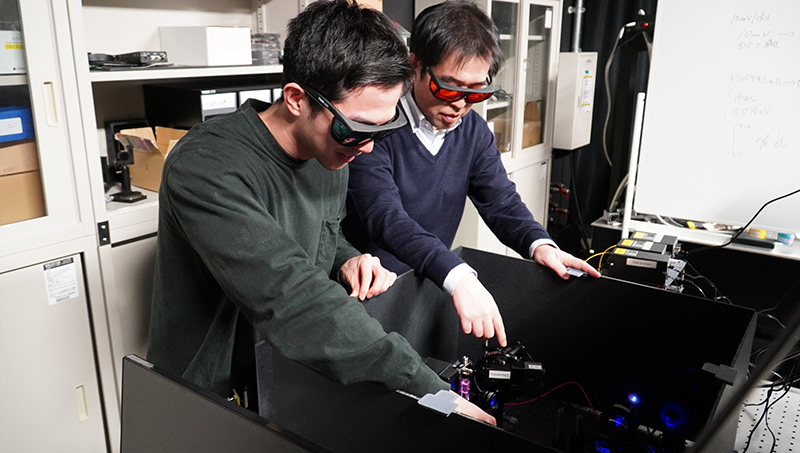
A key feature of our research is a solid foundation in both fundamental device physics and sophisticated experimental techniques. For instance, we have explored OLED operating mechanisms that achieve nearly 100% exciton generation efficiency in traditional fluorescent emitters and developed precise temperature measurement methods for optoelectronic devices. Additionally, our laboratory’s strength lies in its interdisciplinary approach, with team members specializing in condensed-matter physics, optics, and semiconductor devices. This diverse expertise allows us to tackle research challenges from multiple perspectives, often sparking innovative ideas and unexpected discoveries.
What future directions and potential societal applications do you foresee for this research?
Our society is advancing toward a ‘trillion-sensor’ era characterized by widespread data collection and use. In this context, semiconductor devices for sensing, especially light sources, will grow in importance.
Organic semiconductor materials possess distinctive properties that set them apart from traditional inorganic semiconductors. Leveraging these features, we seek to develop innovative devices that will improve future sensing technologies. Creating an ultra-low-power society is an essential goal for achieving a sustainable future.
At present, significant energy is spent on cooling electronic devices and regulating temperatures across different systems. The optical cooling devices we are researching could lower energy use in these areas and contribute to the development of future energy-efficient technologies.
What would you like to say to inspire early-career researchers, students, and society at large?
For me, the greatest motivation in research comes from discovering new phenomena and physical properties. Of course, it is satisfying when experiments produce results that match our expectations. But the most exciting moments often occur when the results are unexpected. Even data that initially appear to be failures can lead to new insights if we carefully examine them and continue thinking about what they might mean. I would encourage young researchers and students not to be discouraged by failure. Instead, I hope they will remain curious, keep exploring, and most importantly enjoy the process of research.


