



A Research Hub Where Diverse Knowledge Fuses to Create Innovation. Research Institute for Electronic Science Awaits Your Challenge
Research Institute for Electronic Science (RIES) integrates knowledge from diverse fields such as physics, chemistry, materials science, life sciences, information science, and mathematical sciences to promote innovative research that transcends traditional academic boundaries.
RIES offers an ideal learning environment for students aspiring to become researchers in various fields, including industry, academia, and national research institutes.
Here, students have the opportunity to learn directly from world-renowned faculty while engaging in cutting-edge research.
With state-of-the-art research facilities and an environment where researchers from diverse fields come together, students can not only deepen their expertise, but also pursue new discoveries and collaborative research across disciplines.
- Learn and grow alongside world-class researchers
- Utilize cutting-edge research facilities to tackle a wide range of themes
- Collaborate with researchers from different fields and contribute to the creation of new science
Why not expand your potential at RIES?
We look forward to the day we can conduct groundbreaking research together with motivated individuals like you to shape the future.
A Research Hub for Pioneering New Science with Creative Ideas and Cutting-Edge Technology.

RIES pursues innovation in electronic technologies to explore uncharted territories in electronic science, advancing research through free-thinking beyond conventional boundaries and diverse methodologies.
In addition to pioneering research in semiconductor materials, devices, and green transformation (GX), RIES engages in a wide range of themes including energy conversion materials, environmental sensing, AI-enhanced nanoscale measurement, healthcare devices, and biological behavior control. Our distinctive research style integrates cutting-edge technologies such as quantum photonics, nanotechnology, and mathematical analysis.
- Faculty members from diverse specialties come together, fostering active interdisciplinary collaboration.
- We actively embrace new ideas and technologies to produce pioneering results.
- Through research, we contribute to the advancement of both academia and industry.
Supporting Your Growth to the Fullest Alongside World-Class Research.
At RIES, we not only advance cutting-edge research but also dedicate ourselves to nurturing the next generation of students through these experiences.
Our faculty, experts in their respective fields, cultivate your knowledge and practical skills through a wide range of undergraduate and graduate courses as well as hands-on research guidance.
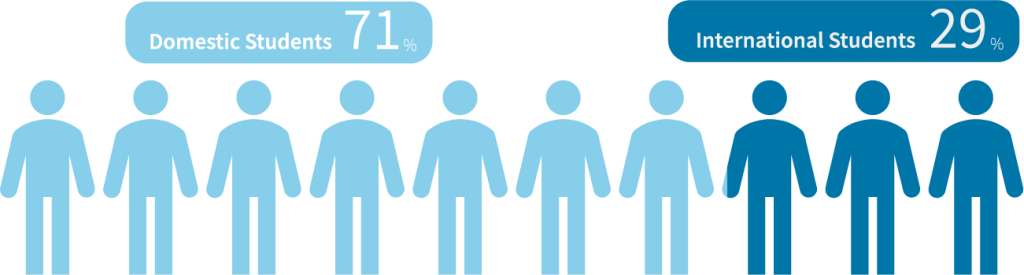
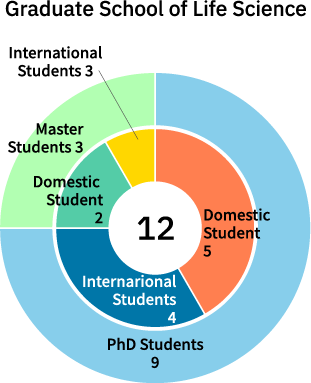
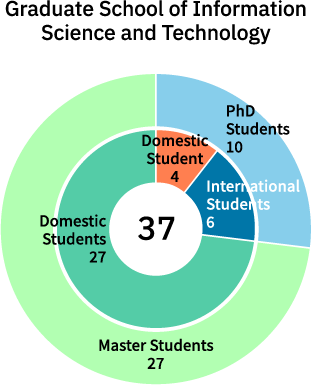
- Approximately 100 students deepen their expertise by engaging directly in cutting-edge research.
- Through advanced research, you can develop the skills needed to succeed on the global stage.
- With dedicated guidance and a supportive environment, we fully support your growth.
Why not take your first step toward becoming a world-class researcher or engineer at RIES?
We warmly welcome your ambitious challenge.
Let’s tackle cutting-edge research that changes the world and open the doors to new science together.


Student Stories
-
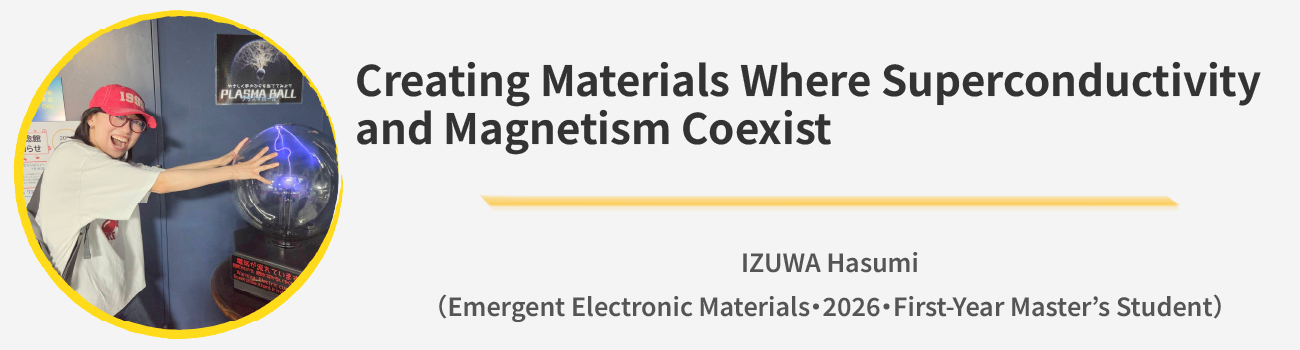
My name is Hasumi Izuwa, and I am a member of the Laboratory for of Emergent Electronic Materials. In this lab, we study superconductivity in transition-metal dichalcogenides such as TaS2. Superconductivity is characterized by zero electrical resistance and perfect diamagnetism. I joined this lab because I was fascinated by the mystery of superconductivity.
I research on the coexistence of superconductivity and magnetism. Since magnetic fields destroy electron pairs, it is difficult for superconductivity and magnetism to exist simultaneously. However, I have succeeded in creating a material in which superconductivity and magnetism coexist by inserting Gd and Fe complexes.
RIES holds an international symposium every year, and I participated in the poster session at last year’s symposium. It was a great source of inspiration to Listen to presentations from various fields and engage in discussions during the poster session. I believe the RIES offers an excellent environment for research, so I recommend visiting a lab that interests you!
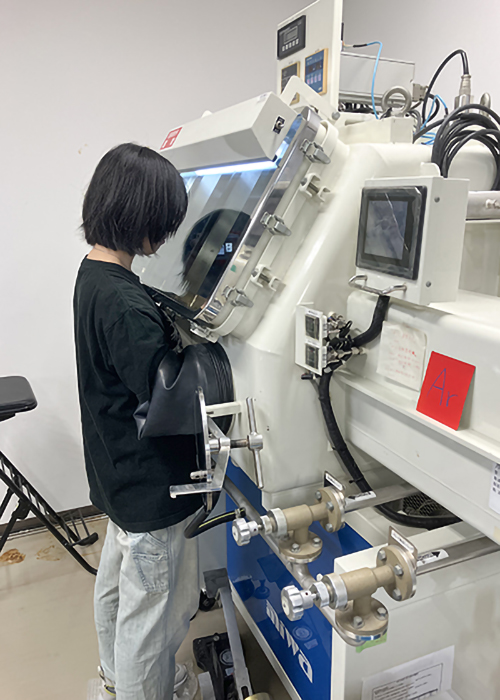
Here I was using a glove box that allows me to work under an argon atmosphere. I use the chemical transport method to grow single crystals, but since the transport agent is deliquescent, I need to use a glove box. 
I enjoy searching for delicious restaurants in Sapporo. This is a photo of a café I stumbled upon in Hachiken.
-
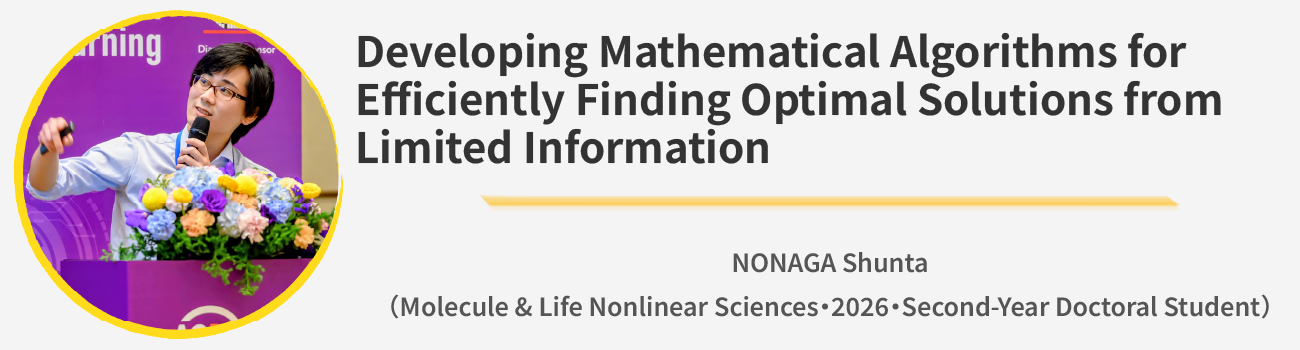
I am Shunta Nonaga, a PhD student at RIES’s Komatsuzaki Laboratory. I joined the institute to pursue data-driven mathematical science within its uniquely interdisciplinary environment, where researchers from diverse backgrounds transcend academic boundaries.
My research focuses on mathematical algorithms—the foundation of AI—aiming to find efficient and safe solutions under limited information. For example, I am developing medical imaging techniques, such as CT scans, to minimize patient radiation exposure while maintaining high precision. Post-graduation, I aim to apply my data science expertise to solve real-world social challenges through advanced technology.
RIES offers an exceptional space for free-thinking and broadening one’s horizons by engaging with different fields. I encourage prospective students to immerse themselves in this stimulating community and let their curiosity explode!
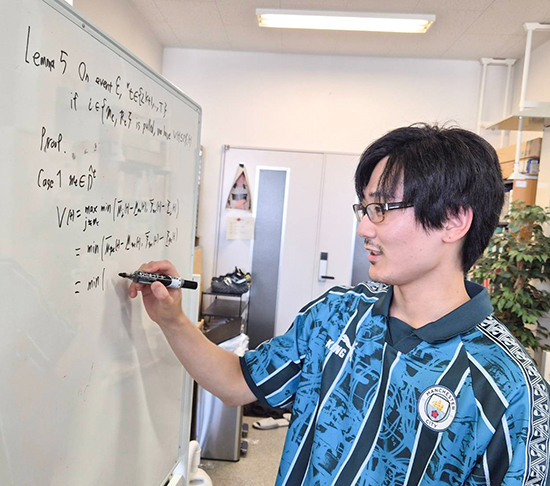
In my laboratory, performing a rigorous mathematical proof for an algorithm I developed. This process is essential for building and refining logical thinking. 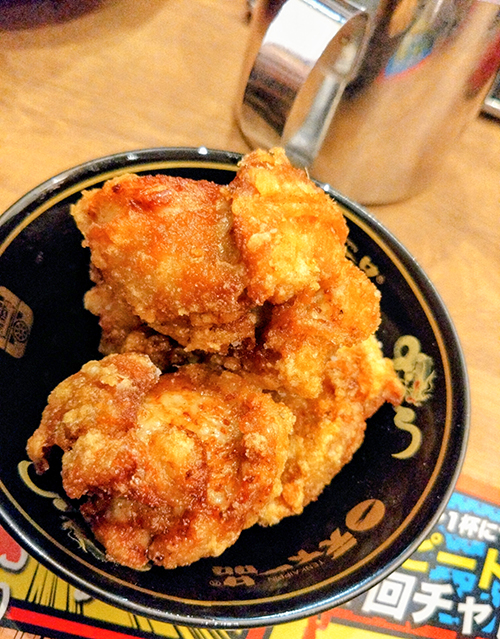
I enjoy exploring delicious food, and my absolute favorite is Karaage (Japanese fried chicken). To me, Karaage is more than just food—it is a form of entertainment!
-
I am Konstantin Kachurin, second year PhD student of Hokkaido-Melbourne dual-degree program in professor Uji-i’s laboratory of Nanomaterials and Nanoscopy at RIES.
My previous research was physics-based simulations of metal microstructure during additive manufacturing, and I joined professor Uji-i’s research to use my knowledge of computational modeling for a new cause that is both more interesting and challenging: calculating heat produced by nanoparticles irradiated with near-infrared light for cancer photo-thermal therapy.
Currently, as I am drafting my first publication, my whole focus is consumed with my PhD research and graduating. That being said, I will be very glad to expand and continue this research even after I complete my PhD.
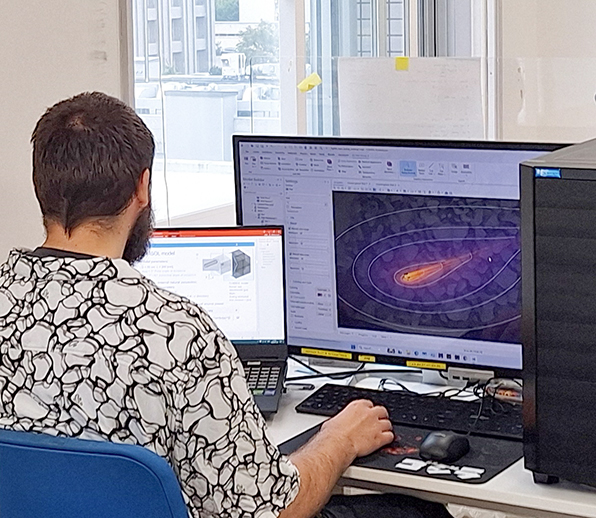
Most of my research is computational modeling, here I am adjusting the visualization of calculated photo-thermal effects. 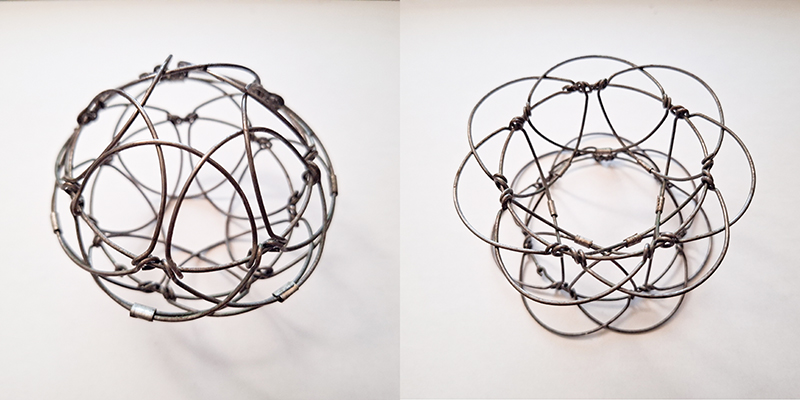
I like crafting things in my free time, for example here is a transforming wire sculpture I made.
-
I am Shintaro Kohata, a third-year doctoral student in the Organic Quantum Optoelectronics Group at the Nakanotani Laboratory. Last autumn, I moved from Fukuoka to Hokkaido and am currently conducting my research in the Nakanotani Laboratory. I chose this research field because I enjoyed studying organic chemistry and photochemistry. I was also fascinated by the fact that light-induced phenomena, such as luminescence, can be observed directly with the naked eye.
My research aims to achieve optical cooling using organic materials. Just as sunlight makes us feel warm, shining light on a material usually increases its temperature. However, when a material efficiently emits light with higher energy than the incident light, heat inside the material can be carried away as light, thereby lowering its temperature. Optical cooling has the advantages of being vibration-free, contactless, and capable of cooling specific areas. It is therefore expected to be applied to semiconductor chips and other devices where heat dissipation is a major challenge. My goal is to develop new cooling devices that take advantage of the unique properties of organic materials, including their light weight, flexibility, and high degree of molecular design freedom.
The Research Institute for Electronic Science is equipped with state-of-the-art research facilities, and active collaborations are conducted with laboratories in a variety of fields. Seminars by researchers from outside the institute are also held frequently, providing many opportunities to learn about research areas beyond my own.
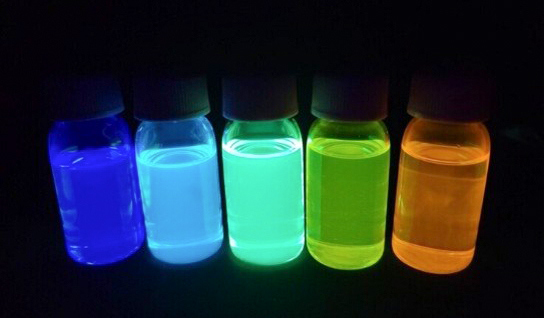
Even slight differences in molecular structure can lead to significant changes in emission color. 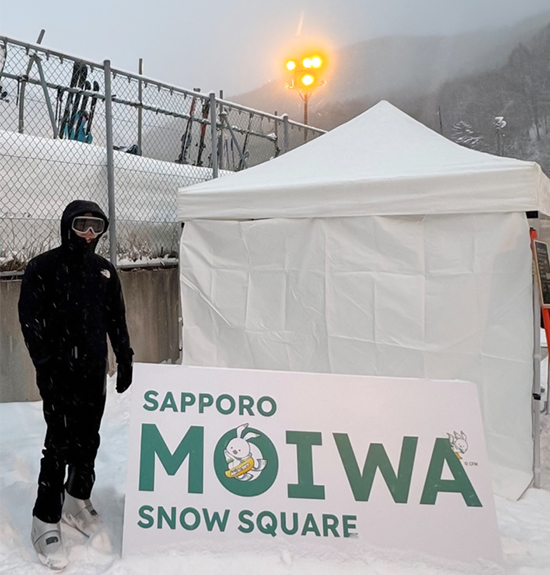
I went skiing twice this year, and I plan to try snowboarding next year.
-
After completing my master’s degree, I worked one year at a microscope manufacturer developing research microscopes. This experience exposed me to needs of biological researchers in Japan and abroad and sparked my interest in advanced microscopy beyond commercial development, leading me to my current laboratory focused on high-speed microscopy.
My research focuses on effective use of high-speed microscopes. Since microscopy requires not only image acquisition but also analysis to extract cellular information, and living cells change dynamically, conventional methods often rely on large 3D datasets. I am developing a system that reduces data by identifying and tracking only necessary cells and their states, enabling equivalent information with far less imaging data.
RIES is an international and interdisciplinary environment. Its location in Hokkaido is also distinctive, allowing us to conduct research while experiencing rich natural scenery and seasonal changes. I encourage you to visit the North Campus and experience its refreshing atmosphere.
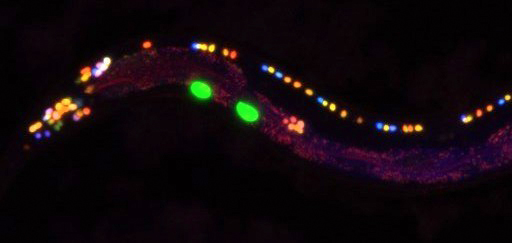
This is a confocal microscopy image of cells in C. elegans, the model organism used in my research. C. elegans has a relatively small number of cells and is a well-established model organism whose cellular functions have been extensively studied. However, to date, there has been no demonstration of simultaneously capturing the activity of all of its cells. 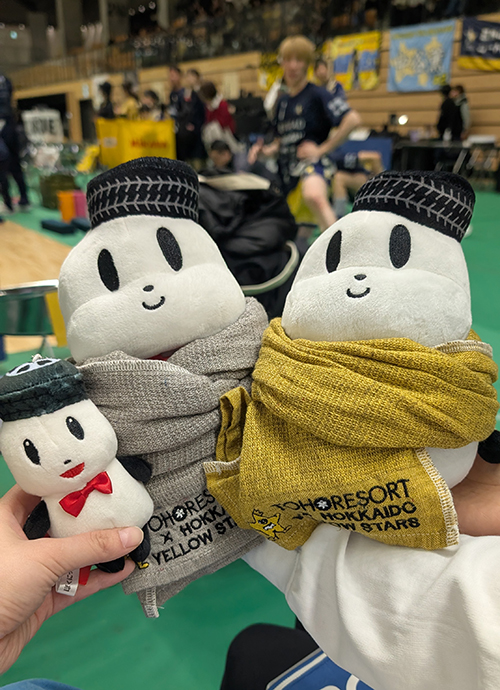
I sometimes go to watch Hokkaido Yellow Stars volleyball games. This is Hokunicchi-kun, the mascot of one of the team’s sponsors!
