


Development of Isomeric Indium Bromide Single Crystals Exhibiting Delayed and Dual-Color Emission
— A promising step toward next-generation light-emitting devices and displays —
A research group at the Research Institute for Electronic Science and the Graduate School of Environmental Science, Hokkaido University (Ms. Haichao Zhou, Dr. Takuya Okamoto and Prof. Vasudevanpillai Biju), in collaboration with the Faculty of Advanced Science and Technology, Kumamoto University (Dr. Kiyonori Takahashi) and the School of Materials Science and Chemical Engineering, Ningbo University (Prof. Jianguo Pan) has successfully developed organic–inorganic hybrid indium bromide single crystals that exhibit both delayed luminescence and dual-color emission.
Light-emitting materials are widely used in technologies such as LEDs and display devices. The emission color and duration (delay) are determined by band-edge electronic and vibrational (phonon) states. Coupling between electron-hole pairs (excitons) with atoms in the material and phonon bottlenecks play a significant role in emission color and rates. In recent years, organic–inorganic hybrid materials, particularly hybrid metal halides, have attracted significant attention for electro-optical and photovoltaic technologies. While many high-performance materials rely on heavy metals such as lead, there is increasing interest in safer alternatives. Indium-based hybrid materials are considered promising because they offer high structural flexibility and reduced toxicity. However, examples demonstrating simultaneous control of multiple emission properties remain limited.
This study demonstrates the design of isomer-like luminescent crystals by combining organic–inorganic hybrid composition containing indium. Single crystals were synthesized from a solution of 4-piperidinopiperidine and indium bromide by heating to 120 °C followed by slow cooling. By adjusting the cooling rate, two crystals with the same chemical formula, (C₁₀H₂₂N₂)₄In₄Br₂₀, were obtained, exhibiting green and yellow emission. Structural analysis revealed that the emission difference arises from distinct arrangements of InBr₄ tetrahedra within a network of InBr₆ octahedra. Time-resolved photoluminescence measurements showed that the green-emitting crystal has a short emission lifetime due to exciton recombination typical of zero-dimensional metal halides, whereas the yellow-emitting crystal exhibits delayed and red-shifted emission originating from self-trapped exciton states through exciton-phonon coupling. These findings demonstrate that subtle atomic-level structural variations within crystals of identical composition can control both emission color and lifetime, providing a new strategy for designing advanced photonic materials.
The discovery of delayed and dual-color luminescence in organic–inorganic hybrid materials based on indium bromide crystals could enable improved optical sensing and color-tunable light sources. The findings also provide new design guidelines for multifunctional hybrid metal halides with controllable emission and strong light–matter interactions.
The article has been published in Materials Horizons on January 29, 2026 (online publication)
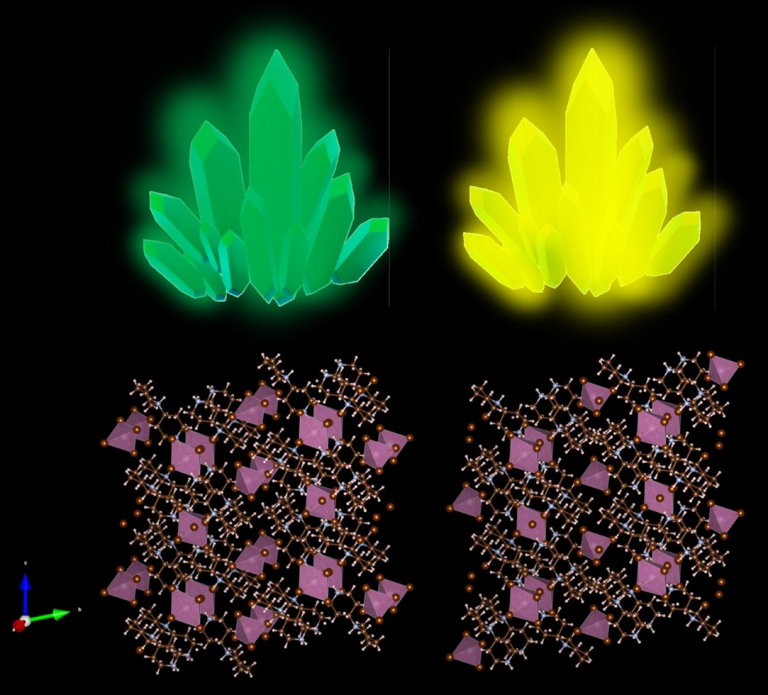
Schemes of green- and yellow-emitting crystals and the corresponding crystal structures.
Information of the paper
Title
Isomeric organic–inorganic indium bromide single crystals with delayed and dual colour emission
Authors
Haichao Zhou,1 Kiyonori Takahashi,2 Takuya Okamoto,1,3 Jianguo Pan,4 Vasudevanpillai Biju1,3
Affiliations:
¹ Graduate School of Environmental Science, Hokkaido University
² Faculty of Advanced Science and Technology, Kumamoto University
³ Research Institute for Electronic Science, Hokkaido University
⁴ School of Materials Science and Chemical Engineering, Ningbo University
Journal
Materials Horizons
DOI
URL
https://pubs.rsc.org/en/content/articlehtml/2026/mh/d5mh02322j
Laboratory of Photonic Nanomaterials
URL https://bijulab.main.jp/en/

