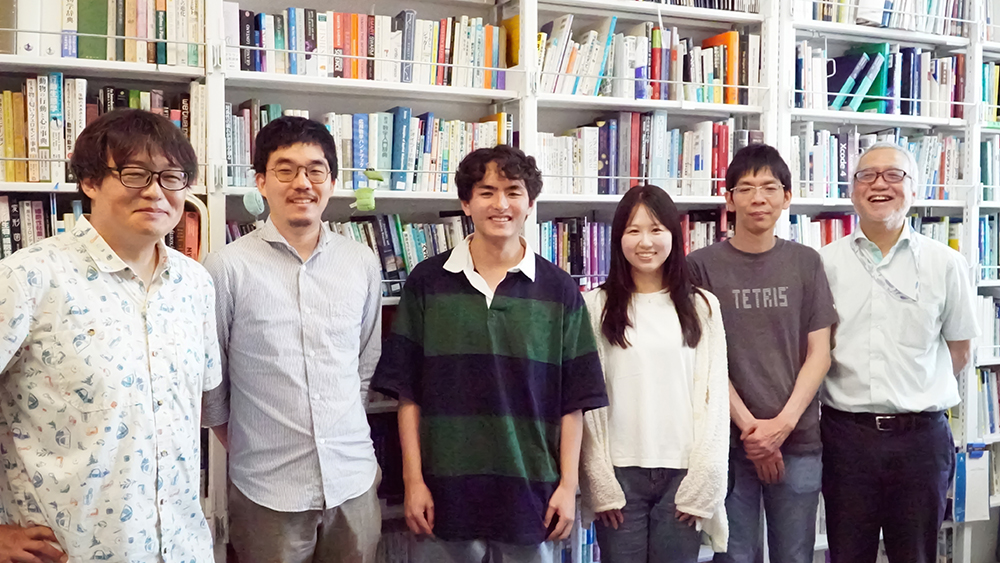





- Could you give us an overview of your research?
- What inspired you to pursue this research topic?
- What do you consider to be the most distinctive features and strengths of this research?
- What future directions and potential societal applications do you foresee for this research?
- What would you like to say to inspire early-career researchers, students, and society at large?
Could you give us an overview of your research?
We are studying the behavior of protozoa in complex environments. Protozoa are eukaryotes that do not include animals, plants, or fungi. They are a group of organisms that exhibit a wide variety of cell morphology, motility and life cycles, ranging from unicellular to multicellular organisms. Well-known examples include amoebae, paramecia, and euglenoids. In complex environments, it is not clear what kind of behavior is optimal. They likely face dilemmas, complicated situations, and accidental events. Since protozoa have survived for hundreds of millions of years in such natural environments, it is believed that they possess their own set of behavioral rules—simple yet surprisingly effective. We are exploring these latent behavioral capabilities and elucidating the information-processing algorithms (heuristics) underlying their behavior. In other words, we are exploring the fundamental nature of intelligence in living organisms. To achieve this, we employ field observations (fieldwork), experiments in complex artificial environments in the laboratory, analysis of the interaction between environment and behavior (mathematical modeling), and the extraction of behavioral control algorithms (heuristics) from the perspective of information science.
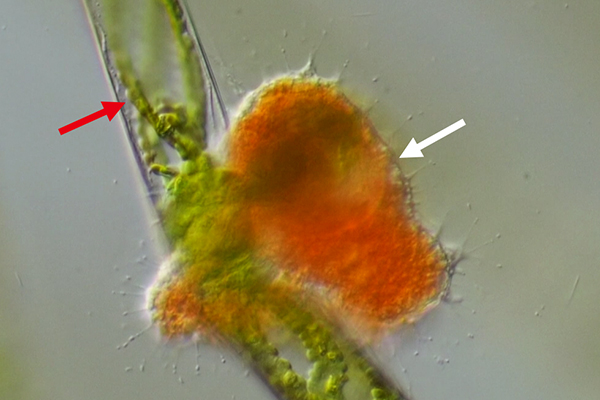
An amoeboid protist that preys on algae. Although it lacks pigments of its own, it appears orange due to pigments retained from the algae it has digested (white arrow). Its genus name is derived from “vampire,” reflecting its feeding behavior: it perforates the cell walls of algal prey such as Spirogyra (red arrow) and sucks out their cellular contents.
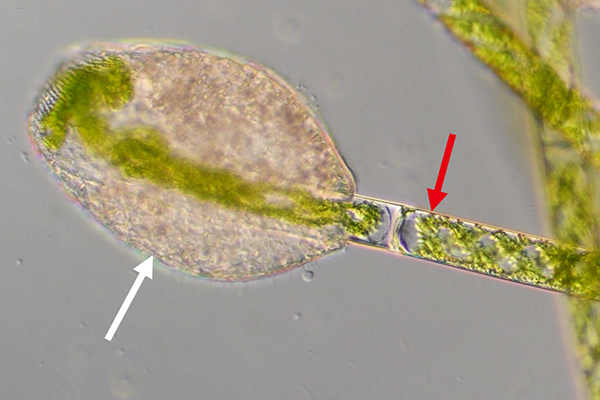
A ciliate (white arrow) belonging to the same group as Paramecium. Unlike most ciliates, this species feeds primarily on Spirogyra (red arrow). Rather than piercing the algal cells, it engulfs whole Spirogyra filaments and digests them internally, an unusual feeding strategy among ciliates. The species epithet spirogyrophagus refers to its specialized habit of feeding on Spirogyra.
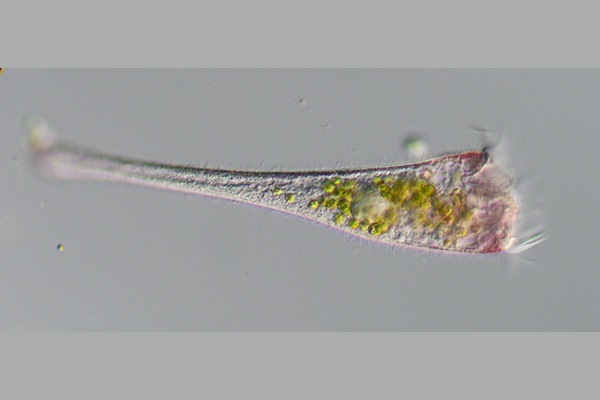
Stentor is a trumpet-shaped ciliate, named after its distinctive morphology. The species shown here is unusual in possessing red pigmentation. Many Stentor species contain characteristic pigments, including the blue-pigmented S. coeruleus and the purple-pigmented S. amethystinus. The species epithet igneus, meaning “fiery,” refers to its flame-like red coloration.
What inspired you to pursue this research topic?
Fascinated by the wonders of self-organization phenomena—such as the chemical waves (rotating spiral waves) observed in the Belousov–Zhabotinsky reaction, a chemical reaction in which malonic acid is oxidized with bromine, and the formation of Benard convection patterns seen in liquid thermal convection—I began to view cellular activity from a physical perspective of self-organization. This line of thinking gained momentum around 1970 and became popular in the 1980s, just as I was a university student.
What do you consider to be the most distinctive features and strengths of this research?
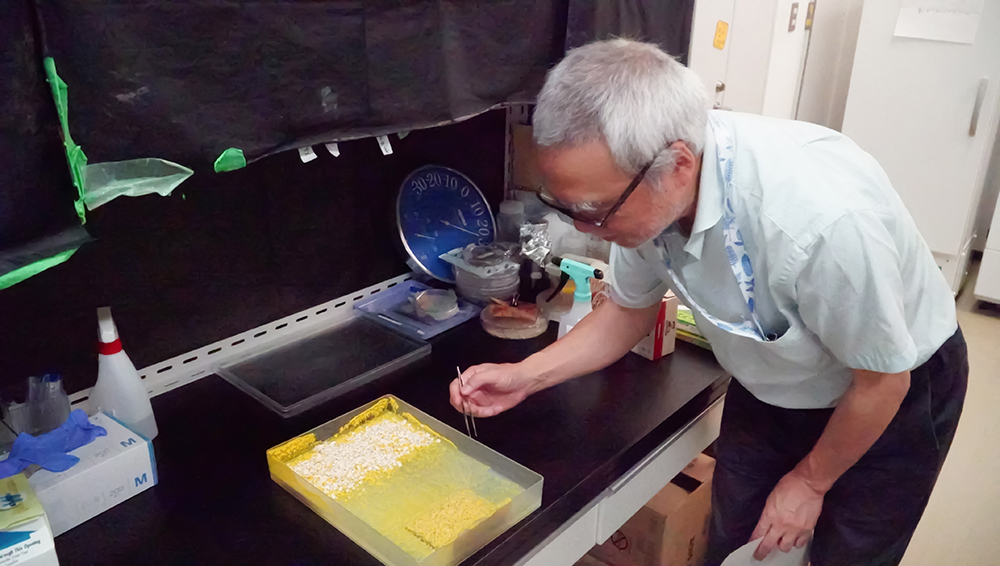
Research on cell movement is undoubtedly one of the major themes in modern biology. As part of this field’s development, we have focused on the complexity of the environment surrounding cells. By investigating cell behavior in complex environments, we have paved the way for exploring the heuristics underlying cell behavior.
What future directions and potential societal applications do you foresee for this research?
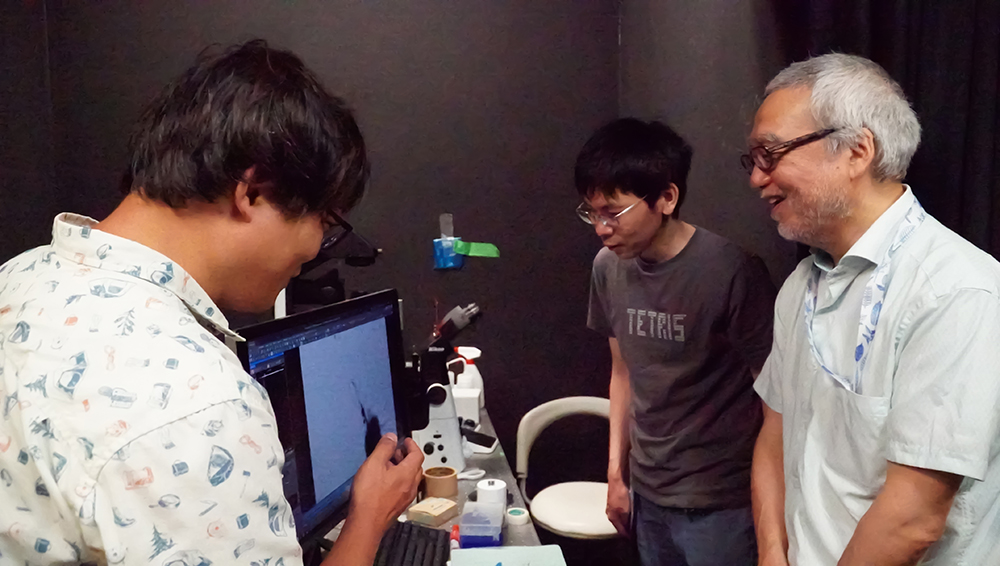
By seeking to understand the behavior of protozoa—which are vital components of ecosystems—we are contributing to a fundamental understanding of how the Earth’s environment is maintained. Furthermore, as we are independently deepening our understanding of the origins of behavioral intelligence as observed in organisms, this is leading us to reexamine traditional views of life.

What would you like to say to inspire early-career researchers, students, and society at large?
I believe that research can be made as interesting as you want it to be, depending on your own perspective. Gently pick up the important things that have been forgotten in the shadow of trends, engage in research exchanges with many people with an open mind, break out of your shell and keep shedding it, and head toward your own unique academic horizons. Go for it. Good luck.