



Biomass-Derived Chitosan as a Loading-Density-Tunable Scaffold for Excited-State Branching and Cocatalyst-Free Photocatalytic Hydrogen Evolution of a Platinum Porphyrin
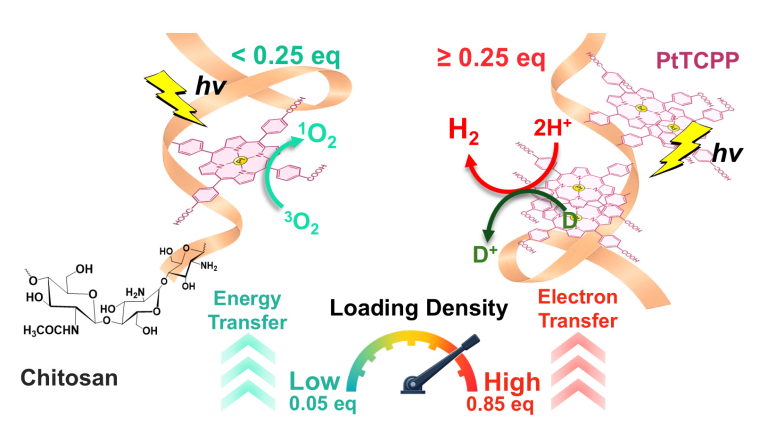
A research group led by Associate Professor Yuta Takano at the Research Institute for Electronic Science (RIES), Hokkaido University, and Kushal Mohan Gowda, a doctoral student at the Graduate School of Environmental Science, has developed a new photocatalytic material using chitosan, a biomass-derived polymer obtained from chitin in crab and shrimp shells.
In dye-based photocatalysts, excessive aggregation of dye molecules usually wastes absorbed light energy, so aggregation has generally been avoided. In this study, the group attached a platinum porphyrin dye to chitosan at different loading densities and used moderate aggregation to its advantage. Spectroscopic and computational analyses suggested that moderate aggregation prolongs the excited-state lifetime, suppresses energy transfer to oxygen, and increases the contribution of electron transfer.
Under 405 nm irradiation in water containing ascorbic acid as an electron donor, the optimal material produced 39.2 mmol of hydrogen per gram of dye per hour in air. This rate is about 10 times that of the material with the lowest dye loading. When the oxygen concentration in the water was reduced, the rate increased to 72.7 mmol per gram of dye per hour. No additional cocatalyst was used. Excessive loading reduced the activity, which shows that controlled aggregation is the key.
The results provide a new design principle for photocatalysts based on biomass-derived materials.
Publication details
Kushal Mohan Gowda, Yasuko Osakada, Mamoru Fujitsuka, Can Liu, Satoru Takakusagi, Hiroshi Uji-i, Vasudevanpillai Biju, and Yuta Takano, “Biomass-derived chitosan as a loading-density-tunable scaffold for excited-state branching and cocatalyst-free photocatalytic hydrogen evolution of a platinum porphyrin,” Journal of Materials Chemistry A, published online on 11 November 2026. DOI: 10.1039/d6ta07314j
Laboratory of Photonic Nanomaterials
URL https://bijulab.main.jp/en/

